
book by Daniel COYLE- New York Times bestselling author.
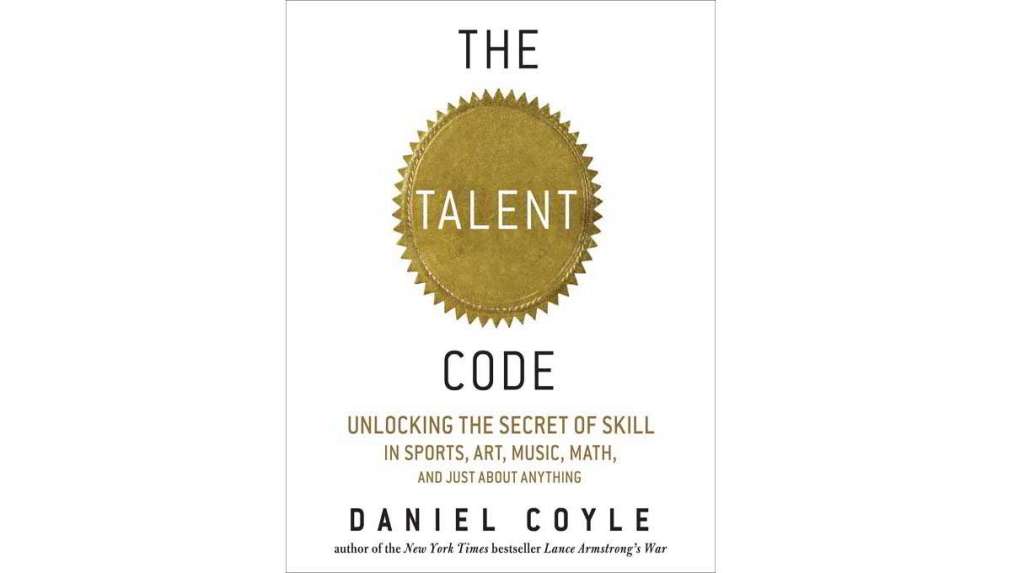
it is a common and incorrect assumption that talent is an inborn trait determined by genetics: some people have it, others do not.
To debunk this myth, Daniel Coyle has travelled the world on a quest to discover which common characteristics are shared by extraordinary talented people, such as Brazilian an football players, Korean golfers, and russian tennis pros. So, while our external environment does play an important part, the answer actually lies in the biological processes of the human mind. We can reach our full potential by working on the three components described in The Talent Code: practice, motivation, and coaching.
Many useful tips to:
-Reflect on talent and how it is traditionally conceived.
-Improve your memory and learning techniques.
-Discover the “Talent code” and how to use it to develop your skills.
- The talent code contains three elements: practice, motivation, and coaching.
There are places around the world that seem to mass-produce people wit extraordinary talent who are able to achieve world-class as musicians, writers etc. etc. So what sets these countries apart? Is talent an innate quality that we are born with, and that depends exclusively on our DNA?
Contrary to popular belief, everyone is capable of developing skills by following the three elements of Coyle’s Talent Code: Practice, motivation and coaching.
- Neurons and synapses are vital for learning, but myelin is essential for precision.
It is a no coincidence that the branch of science that studies the brain was named neurology. While neurons and synapses explain almost every class of neurological phenomena myelin, plays the most important part.
- The greater the number of synapses, the higher the quantity of myelin
Bill Greenough conducted an experimenton 3 groups of rats. This study was instrumental in confirming the theory of brain plasticity and the importance of enviromental factors on development. Myelin in rats’ brains had also increased by the same amount, but the implications of this finding were still unknown at the time.
- Memory is not fixed, but is developed through training. Experience is the result of “deliberate practice”.
Working from the assumption that every skill is a form of memory, Ericsson began to wonder how these mechanisms were linked to talent and the extraordinary skills of a few individuals. So he studied the talent process by measuring the time and characteristics of practice.
- Brazil: a land of world-class footballers who hone their skills playing futebol de salao.
No wonder Brazil is a world leader in football, but the outsatnding talent of Brazil’s footballers is also down to Futebol de salao “soccer in the room”, invented in 1930s. Futsal is played indoors on a wooden-floored “pitch” the size of a basketball court the ball is smaller and heavier.
- Whether we want to become a famous novelist or pro-skateboarder, the basic requirement is the same: constant practice.
The bronte sisters grew up ina lively environment, in a house filled with magazines. These practice-writing sessions were precisely what enabled them to go on to write their novels. This exercise yielded the familiarity and the skills that they would late put to good use.
- Human skills are dependent on myelin.
- Dividing an activity into smaller parts allow us to concentrate and correct mistakes ona smaller scale.
What seperates great athletes aand musicians from everyone else, is their ability to create connections and work on one movement after another, and then put them all together.
- Finding the primal cues that ignite passion: the importance of ignition.
Passion is a common trait shared by all great performers in any field. Constant and repetitive practice is impossible to sustain if it is not driven by a strong need or deep desire, which transforms the simple acts of training, playing, or studying into our reason for living.
Strong motivation is an irrational force: we do not think about the hard work, sacrifice, or present moment; we think and act in the long run, focused on a far-away goal, and we are willing to invest huge amounts of energy to achieve it.
A good coach “whispers” to their trainees, motivates them, and guides them to success.
The third eement is the coaching, which is what links intense practice and passion. One key figure symbolising the importance of coaching.
Much more about about daniel:
° https://www.goodreads.com/book/show/5771014-the-talent-code
 mybespokes.com